
This is a reprint of Tema’s original review, which appeared in the Historical Novel Society’s August 2026 issue.
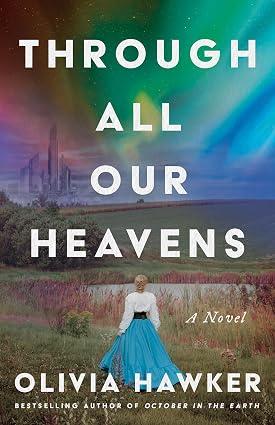
At a time when so many authors are raging about artificial intelligence (AI), it is startling to read a novel that presents a positive future of a world living in blissful harmony thanks to everyone being perpetually connected to advanced AI. Before you angrily turn away, note that it is contrasted with civil war violence. If everyone automatically empathizes with everybody, surely, we would be incapable of harming each other and would see no reason to do so.
Olivia Hawker’s dual-timeline novel starts with the real-life Carrington Event, a solar flare and geomagnetic storm that caused several days of brilliant Northern-lights-style illuminations worldwide in 1859. Helen Bywater, a well-to-do slave-owner and artist in Richmond, Virginia, at a time when the US Civil War is brewing, has visions during the event that convince her that slavery is evil and she must work to end it.
Meanwhile, in 2053, art historian, Derren Witt, risks leaving the safety of her “Integrationist” life in California to travel to the war-torn Northeast to evaluate a cache of paintings by Helen that seem to depict life in the modern world. When a new solar flare event happens, Derren must survive without her AI, under attack by the anti-AI Human Heritage Movement.
I struggled to accept Helen’s overnight conversion and found her repetition of the justice of her cause overly didactic. However, the story kept me reading and rooting for her as she tried to undermine the Confederacy. In the near-future world, I loved Hawker’s descriptions of the sluggishness of a brain that has become unaccustomed to thinking on its own, and the notion of how difficult a decision it would be to give up your independence and submit to AI, even when you can see the positives.
You may also be interested in this Substack post, in which I contrasted the views of this novel and that of Yiming Ma’s book, These Memories Do Not Belong to Us.
Read all my book reviews here.